
September, 2026
One Woman’s Experience with the Internal Armed Conflict
During Guatemala’s Internal Armed Conflict, the Maya population was targeted. Their choices were few: move to a so-called “Model Village,” and be under constant surveillance; hide in the mountains as a “Community in Resistance,” trying to survive while avoiding violence; join a guerrilla group and fight; or flee the country. In our last edition, we learned that the family of our guest, whom we’re calling Luisa, decided to hide in the mountains as a Community in Resistance. They stayed until it got too dangerous and they decided to go to Mexico.
Continued from our May edition...
“We headed out. We didn’t get to Mexico in one day. Little by little we got closer and arrived at the border. But crossing the border was a huge risk as well, because it was controlled by the (Guatemalan) army. But, while the army slept at night, we stayed awake. And because we had acquaintances at the border, one closest to the border said, ‘we can’t cross here. Let’s look for a stream (In Guatemala we call them sanjuanes) where a little water flows’. We walked through the stream so they wouldn’t see our footsteps, where we had passed. At night, we crossed the border and arrived under the mountains in Mexico where we stopped. What were we going to do now?
There was a Mexican man, the owner of a huge pasture, a huge pasture, where there was livestock. A person said, ‘what do we do? Let’s let the owner know we’re here.’ Two fathers left. Four men went to speak, and the Mexican man was nervous, ‘what are you doing here?’
Well, he knew there was a war in Guatemala. They said, ‘look we are here,’ to the Mexican man, who was named Antonio. And, ‘OK, don’t worry,’ he said…’You can stay here. No problem.’ At this time, I was older, I was twelve. And the people weren’t abandoned because, always, there was the Army of the Poor. They were soldiers of the people, the Guerrilla Army of the Poor. They were the ones who took care of our people. They arrived to see the people, how they were living, to be sure the army wasn’t there. They were taking care of us and reassured the Mexican man not to be afraid because they weren’t soldiers, they weren’t the army. They were equal to soldiers, but they told him that they were not the army of the government. They were the Army of the Poor.
[The Army of the Poor] said, ‘OK, for those 12 years and older, we’re going to give you a class. You’re going to learn a lot about how to defend yourselves against the army.’
I said, ‘I’ll go.’ I thought it was to learn how to write, but it wasn’t.
So we were prepared to be trained. Sometimes it was explained that it was a training where one could defend against the army. I went. When one is a young person, one doesn’t know what’s going to happen in one’s life…I went but my parents stayed behind.
I had to return to Guatemala where they trained us. But nothing could be done in Guatemala. They brought us to the Lacandona Jungle in Mexico. It was a huge jungle, huge, with huge trees. We trained there for six months and there I got sick with hepatitis. But thanks to God I am here. I say that because it was a miracle from God because I stopped eating. I couldn’t eat because there wasn’t good food. We carried what we call here pinol, something like flour. It’s made of corn, ground until it’s fine. The flour was spoiled. There were bugs inside. It didn’t taste good. But that’s how we ate.
With my illness, I didn’t travel, I wasn’t thriving. They sent me again to the mountains of Guatemala.
I recovered, slowly, I became stronger. And after, I entered the guerrilla army. But there was suffering. I couldn’t dress myself properly. You wore what you found... sometimes men’s clothing. And there wasn’t enough clothing. At least I had a pair of pants and a shirt. We slept in wet clothes, with broken boots. My feet were peeling and full of blood…because every day it rained. And I cried a lot because of the pain, so much pain, and there was nowhere to find medication, there was no way to bear [the pain from a head wound]. I couldn’t see where I was walking. I cried from the pain and I didn’t know where they were going to find pills. They gave me amoxicillin which worked to get rid of the pus. Well, those were difficult days.
After four years in the mountains with the guerrillas, I had another health problem. [There was] a doctor from Cuba who arrived in the mountains and started to give consultations. He told me I had a stomach infection. If it wasn’t a tumor, it was possibly a cyst.
Everything hit me harder and harder back then. I had lost contact with my parents. They’d moved further inside Mexico because it was said that the Army violated the rights [of the refugees] to enter there. And where had my parents gone? I was totally lost to them. I couldn’t find where they were.
After some time, they told me, ‘Your parents are...in a village called Maravilla. They live there now...’ Well, now what do I do?
I got sick again…and I told the person in charge, ‘I’m not staying, I’m going to Mexico. I’m going to look for my family because …I can’t stay here in this situation. Nothing, to me, is better than being with your family.’
I reunited with my family, and talks began about the return [of the refugees to Guatemala]. There were two meetings in Mexico with permanent commissions that had something to do with the situation in Guatemala. There was a women’s organization called Mamá Maquín. Between them, they were looking for how to organize our return. My husband had earned his training in human rights. He had a human rights diploma. So with the Permanent Commission, the organization Mamá Maquín and the human rights workers, they were looking for how to form an organization.
We organized our return, arriving in different parts, spending time, looking where to sleep. We arrived in the outskirts of Coban. They took us by plane to Ixcán. But, in those days, what fear we had because...we saw the army there, marching, parading there. With this fear that had passed with those bombers. Such fear we had when the plane landed.
We looked for a place to stay. We were in the municipality for three days and then we went to Victoria, the 20th of January. This was the first group of returned refugees. We were there and we started to realize that there wasn’t enough land for all of us in this first block of returned refugees. We had to look for land again.”
Luisa and her community eventually found their land. Luisa, a woman who couldn’t attend school because of the Internal Armed Conflict, became a community leader and saw each of her children graduate from school.
During the Internal Armed Conflict in Guatemala, over 200,000 people were killed. Between 500,000 and 1.5 million people left their lands. At least 625 villages were completely destroyed.
News:
Santa Elena recently hired a third elementary school teacher and now offers Kindergarten classes to 28 students aged 4 and 5.
In June, Copal AA shared that they are educating 90 students from 17 communities, most of whom speak Q’eqchi’. Other students speak Mam, Q’anjob’al, and Kiche. This diversity in terms of culture, traditions, customs and wisdom is deeply valued by the community. Since January, the students have done a variety of activities including farm work, community art, and the celebration of Mother Earth. The students are happy to have their new school kitchen where they can prepare foods raised from the school garden and share culinary traditions.
Our new bilingual website is nearly complete! More details to come in our next newsletter!
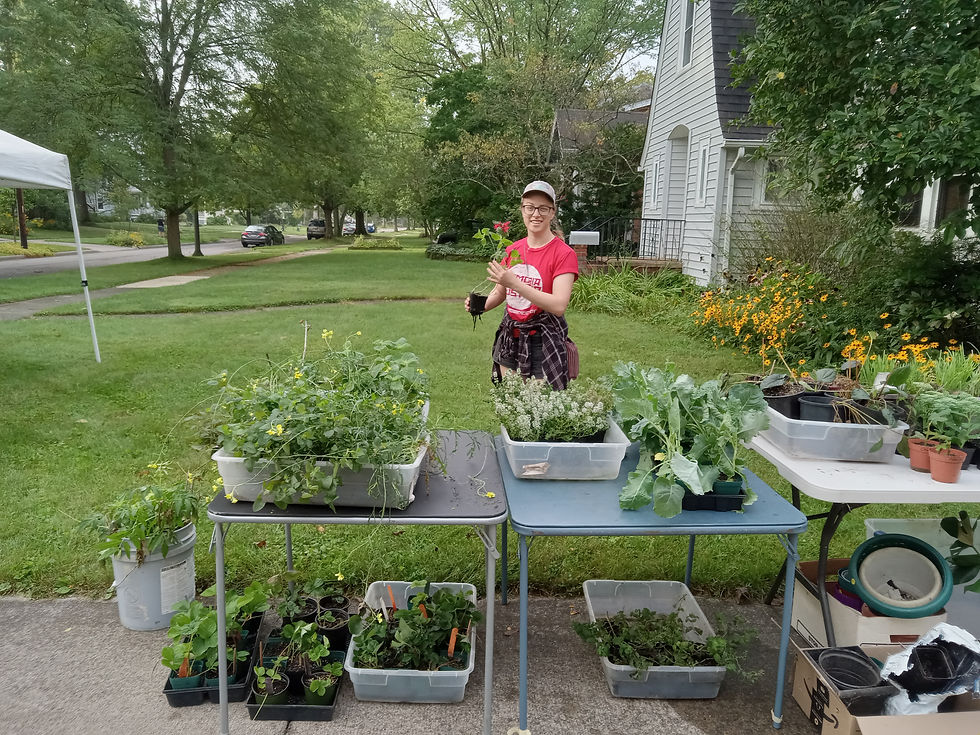
Our plant/garage sale will take place on September 5 at 26 King Street in Oberlin. Vice-Chair Sarah Johnson will provide herb seedlings, berry starts, rose cuttings, and flower bulbs as well as kombucha start-up kits and vermicompost. Coffee and homemade treats will also be available for purchase. If you have any gently-used items or plants you wish to donate to our sale, please be in touch to arrange a pickup: lori@sepaoberlin.org or kelly@sepaoberlin.org. Thank you to Rust Belt Riders for their soil donation.
Save the Date:
Our Annual Dinner is scheduled for April 3, 2027.
Email Change:
Note that we are changing our email addresses: Lori@sepaoberlin.org or Kelly@sepaoberlin.org.


Comments